
 adrienne
Supporting women’s rights in Canada means taking deliberate action to advance gender equality, whether through grassroots organizing, financial contributions, policy advocacy, or everyday allyship. Each of these pathways matters because systemic change requires both large-scale institutional shifts and countless individual choices that challenge discrimination and amplify women’s voices.
The landscape of women’s rights advocacy in 2026 remains urgent. Despite decades of progress, Canadian women still face a persistent gender wage gap, disproportionate caregiving burdens, and barriers to leadership positions across sectors. Indigenous women, women of colour, disabled women, and transgender women navigate compounded layers of discrimination that demand intersectional solutions. Meanwhile, reproductive rights face ongoing challenges, and gender-based violence continues at alarming rates.
Yet here’s what often goes unsaid: supporting this movement doesn’t require transforming your entire life overnight. The most sustainable advocacy grows from your existing strengths, resources, and community connections. A donation to a local women’s shelter creates immediate safety. Mentoring a young woman in your field opens doors. Calling out casual sexism in a meeting shifts workplace culture. Attending a municipal council session about affordable childcare puts pressure on decision-makers.
What makes support truly effective is consistency and a willingness to learn. The women’s rights movement has always been powered by people who showed up, made mistakes, adjusted course, and kept going. Your contribution, whatever form it takes, adds to a collective force that has already achieved remarkable change and continues pushing for the full equality that every Canadian woman deserves.
What Supporting Women’s Rights Really Means
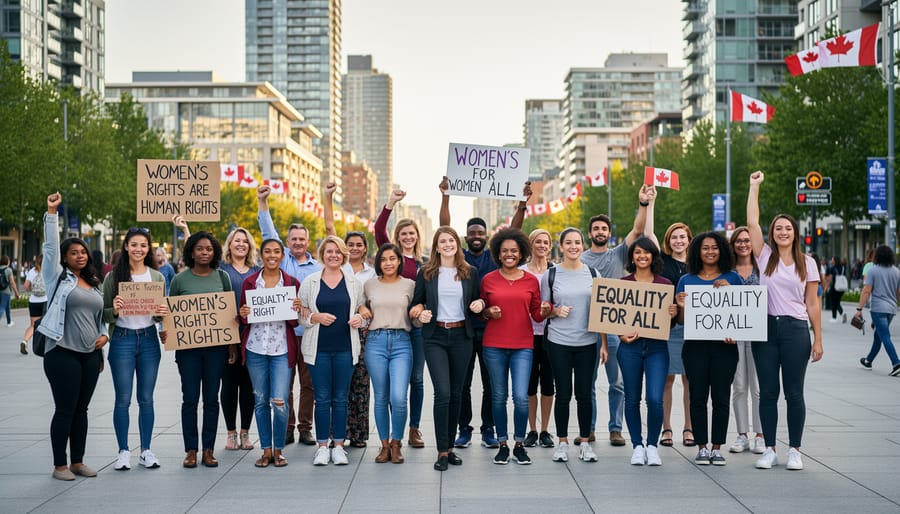
Supporting women’s rights starts with recognizing that agreement isn’t enough. True support demands active participation, whether that’s challenging sexist remarks at work, showing up to rallies, or rethinking the systems we operate within daily. It’s the difference between nodding along when someone mentions the wage gap and actually advocating for transparent salary bands in your workplace.
In the Canadian context, this means understanding how support looks different across communities. For an Indigenous woman fighting for clean water in her community, support might mean amplifying her voice to decision-makers. For a newcomer navigating workplace discrimination, it could involve connecting her with legal resources or standing beside her when she files a complaint. Support isn’t one-size-fits-all; it adapts to the specific barriers women face.
Allyship requires more than good intentions. It means doing the uncomfortable work of examining your own biases, stepping back when women need to lead, and using whatever privilege you hold to open doors rather than just walking through them yourself. This includes deconstructing patriarchy in spaces where you have influence, from family dynamics to boardroom decisions.
Solidarity shows up in everyday moments. It’s the father who takes parental leave, normalizing caregiving as everyone’s responsibility. It’s the colleague who interrupts when a woman gets talked over in meetings. It’s the community member who votes for candidates committed to reproductive rights and childcare funding. These actions, multiplied across thousands of people, create the cultural shifts that make gender equality possible.
Support also means staying engaged when the spotlight fades. Women’s rights aren’t a trending topic to abandon when the next issue emerges. Real change happens through sustained commitment, showing up consistently, learning continuously, and recognizing that this work benefits everyone by creating fairer, more equitable communities.
The Current State of Women’s Rights in Canada
Canada’s journey toward gender equality has been marked by meaningful victories and persistent challenges. While we rank among the world’s leaders in many gender equality metrics, the reality for women across this country varies dramatically based on geography, income, ethnicity, and identity. Understanding where we stand today helps us see why ongoing support remains critical.
On the progress front, women now make up nearly half of Canada’s workforce and hold increasing numbers of leadership positions in business, government, and academia. Legal protections against discrimination have strengthened, and conversations about what patriarchy is and how it operates have moved from academic circles into mainstream dialogue. Many workplaces have implemented parental leave policies that go beyond minimum requirements, and awareness of gender-based issues has never been higher.
Yet significant gaps persist. Women still earn approximately 87 cents for every dollar earned by men, with the gap widening for racialized women and women with disabilities. Intimate partner violence statistics remain troubling, with one in three women experiencing some form of physical or sexual violence in their lifetime. Access to reproductive healthcare varies wildly by province and region, with rural communities facing particularly stark limitations.
The situation for Indigenous women demands urgent attention. Indigenous women outcomes lag behind national averages across nearly every indicator, from income and employment to health and safety. The ongoing crisis of Missing and Murdered Indigenous Women and Girls continues despite the National Inquiry’s calls to action.
Trans women and non-binary people face unique barriers, from healthcare access to employment discrimination. Women with disabilities navigate systems not designed with their needs in mind. Newcomer women often struggle with credential recognition and language barriers that limit economic participation.
These realities exist not because progress is impossible, but because sustained effort and support are required to transform systems built on exclusion. Every advance has come through persistent advocacy, and every remaining challenge represents an opportunity for meaningful engagement.
Ways to Support the Women’s Rights Movement
Amplifying Women’s Voices

Amplifying women’s voices starts with something deceptively simple: listening. Not listening to respond or fix, but listening to understand the lived experiences of women navigating systems that weren’t built with them in mind. Pay attention to who speaks, who gets interrupted, and whose ideas get credited in your workplace, community groups, and social circles. When you notice patterns of erasure, call them out gently but clearly.
Centering marginalized voices means actively seeking perspectives from Indigenous women, racialized women, disabled women, trans women, and others whose experiences differ from mainstream narratives. Follow their work, share their content with proper credit, and redirect attention when conversations about women’s issues default to the most privileged experiences. When organizing events or campaigns, invite diverse speakers and compensate them fairly for their expertise.
Challenge spaces where women remain underrepresented by asking pointed questions. Why are all the panelists men? Who decided this leadership team? Your questions alone can shift decision-making. Use whatever privilege you hold, whether based on gender, race, class, or position, to open doors and then step aside. Recommend women for speaking opportunities, awards, and promotions. Amplification isn’t about speaking for women; it’s about ensuring they’re heard.
This work directly supports systemic change by reshaping who holds authority and whose knowledge counts as legitimate. When women’s voices guide policy, research, and community decisions, the solutions better reflect everyone’s needs.
Financial Support and Resources

Your financial contributions, no matter the size, fuel the organizations working daily to advance gender equality in Canada. Grassroots groups often operate on shoestring budgets, yet they provide front-line services, run community programs, and drive policy change that reshapes lives.
Monthly donations offer stability. Organizations like the Canadian Women’s Foundation, which funds hundreds of community initiatives across the country, can plan long-term programs when they have predictable support. Even $10 monthly adds up to meaningful impact over a year. One-time gifts matter too, especially during campaign drives or in response to urgent needs.
Supporting women-owned businesses creates economic ripples. When you purchase from women entrepreneurs, you’re investing in financial independence that challenges systemic inequality. Look for women-led companies in your community or explore directories like ShopHER Canada that connect you with diverse business owners.
Consider where your existing spending goes. Can you redirect your gym membership to a women’s community centre? Could you choose a credit union that actively supports gender equity initiatives? Financial institutions like Vancity have dedicated lending programs for women entrepreneurs facing barriers to traditional funding.
Indigenous-led organizations such as the Native Women’s Association of Canada need sustained support to address the specific challenges facing Indigenous women. Legal funds defending reproductive rights require resources to challenge restrictive legislation. Crisis centres helping survivors of violence depend on donors to keep their doors open.
Your money becomes power when it lands in the right hands.
Advocacy and Community Organizing
Advocacy starts closer to home than most people realize. Your municipal councillor, provincial representative, and federal MP all respond to constituent concerns, and your voice carries weight. A well-timed email about funding for sexual assault support services or affordable childcare can shift a policy conversation. Phone calls work even better; staffers track volume on specific issues, and a handful of calls signals that constituents care. When you frame your ask around local impact rather than abstract principles, you make it harder to ignore.
Community organizing creates sustained pressure that individual actions can’t. Join an established group working on an issue you care about, whether it’s reproductive justice, pay equity, or ending gender-based violence. Organizations like the Canadian Women’s Foundation and local feminist collectives always need people to table at events, canvas neighbourhoods, host information sessions, or coordinate rallies. You don’t need credentials. You need consistency.
Building solidarity networks means showing up for causes that intersect with gender equality even when they don’t center you directly. Attend town halls on Indigenous land rights. Support campaigns addressing anti-Black racism. Advocate for accessible transit and housing, which disproportionately affect women living in poverty. This is allyship in action: recognizing that systems of oppression reinforce each other and that dismantling them requires cross-movement collaboration.
Advocacy isn’t a single petition or one march. It’s the deliberate, repeated act of making women’s rights impossible to sideline. Whether you’re organizing a workplace equity committee or texting ten friends about an upcoming vote, you’re shifting what’s politically possible.
Overcoming Barriers to Support
Many people genuinely want to support women’s rights but feel held back by uncertainty or fear. You might worry about saying the wrong thing, not knowing enough, or facing pushback from people close to you. These hesitations are normal, and acknowledging them is actually the first step toward meaningful engagement.
The fear of making mistakes stops many potential allies from taking action. But perfectionism isn’t a prerequisite for advocacy. Women’s rights movements have always grown through learning, and your willingness to listen, adjust, and keep showing up matters more than getting everything right immediately. Start by following women-led organizations and voices, pay attention to how they frame issues, and don’t be afraid to ask questions respectfully when you’re unsure.
Financial constraints present another common barrier. Supporting women’s rights doesn’t require money, though donations certainly help organizations doing critical work. You can challenge harmful norms in everyday conversations, share credible information on social media, attend free community events, or volunteer your skills. Time contributions often create just as much impact as financial ones.
What if I make mistakes when talking about women’s rights?
Mistakes are part of learning. When you mess up, apologize sincerely, correct yourself, and move forward without centering your discomfort. The movement values genuine effort and growth over performative perfection.
How do I talk about this with family members who disagree?
Focus on shared values like fairness and safety rather than getting caught in political labels. Share personal stories and concrete examples instead of abstract arguments. Sometimes planting seeds takes time, and protecting your own wellbeing matters too.
What if I don’t feel qualified to advocate?
You don’t need credentials to support equality. Your lived experience, compassion, and willingness to learn are enough. Start small, amplify others doing the work, and remember that collective action includes many different roles.
Navigating disagreement with friends or family feels particularly challenging. You can set boundaries while staying engaged, choosing when to have difficult conversations based on your energy and the likelihood of productive dialogue. Sometimes the most powerful advocacy happens through your own choices and how you show up in your community, creating change by example rather than confrontation.
The Ripple Effect: How Your Support Creates Change
Every gesture of support you offer radiates outward, creating waves of change that reach farther than you might imagine. When you speak up in a meeting, share a resource, or donate to an organization, you’re not just completing an isolated action, you’re contributing to a groundswell of momentum that shapes culture and policy across Canada.
Consider how the #MeToo movement transformed workplace dynamics. It started with individual women sharing their stories, then allies amplifying those voices, and eventually led to concrete changes in Canadian legislation around harassment and disclosure agreements. Each person who participated, whether by sharing their experience or simply listening and believing, helped dismantle systems that had protected abusers for generations. That’s collective power in action.
The same pattern repeats in communities across the country. When parents in Calgary challenged school dress codes that disproportionately targeted girls, their advocacy sparked similar reviews in districts nationwide. When advocates in Vancouver fought for accessible childcare, their success became a blueprint for other municipalities. Your local action becomes someone else’s inspiration and roadmap.
Supporting women’s rights also creates change in your immediate circles. When you challenge a sexist comment at a family dinner, you show younger relatives what allyship looks like. When you recommend a woman for a leadership opportunity, you help shift who gets access to influence. These moments might feel small, but they reshape norms and open doors.
The truth is, systemic change never happens through one heroic act. It builds through countless people making consistent choices to support equality. Your contribution matters because movements are made of individuals deciding that women’s rights are worth their time, voice, and resources. Together, those decisions become unstoppable.
Supporting women’s rights isn’t a single decision you make once and then move on from. It’s a practice, something you return to again and again as you learn, grow, and see new opportunities to create change. Every conversation you have, every organization you support, every time you speak up makes a difference in building the Canada we want to live in.
The movement for gender equality needs all of us. It needs your unique perspective, your networks, your voice. Whether you’re just starting to explore what support looks like or you’ve been advocating for years, there’s always room to deepen your engagement.
Think about what resonated most as you read this article. Was it amplifying voices? Financial support? Community organizing? Pick one area and commit to taking action this week. Sign up for a newsletter from a women’s rights organization. Attend a local event. Have that conversation you’ve been putting off.
When women thrive, families thrive. Communities become stronger. Our economy grows more robust and innovative. Supporting women’s rights benefits everyone, not just women.
Your next step doesn’t have to be perfect. It just has to be real. The movement is waiting for you, and together, we’re creating lasting change.


