
 adrienne
Economic justice means everyone has fair access to financial resources, safe work, and the power to build a secure future. For women in Canada, that promise remains unfulfilled. We earn less over our lifetimes, shoulder unpaid care work that keeps entire households running, and face barriers to housing, credit, and leadership roles that men rarely encounter. This isn’t about individual choices. It’s about systems that undervalue women’s contributions and limit our economic power.
Economic inequality shows up in women’s lives in concrete ways: single mothers stretching paycheques that don’t cover rent, older women retiring into poverty after years of unpaid caregiving, and Indigenous and racialized women navigating workplaces built to exclude them. These patterns aren’t accidents. They’re the result of policies, workplace practices, and cultural norms that treat women’s economic security as optional.
Understanding economic justice gives us the language and tools to demand better. It connects the dots between a mother’s struggle to afford childcare and a government’s budget priorities. It helps us see why closing the wage gap requires more than asking women to negotiate harder.
This article breaks down what economic justice actually means, why gender and economics are inseparable, and how Canadian women are already building fairer systems. You’ll find clear explanations, real stories from communities across the country, and practical steps to join the movement for change.
What Economic Justice Actually Means
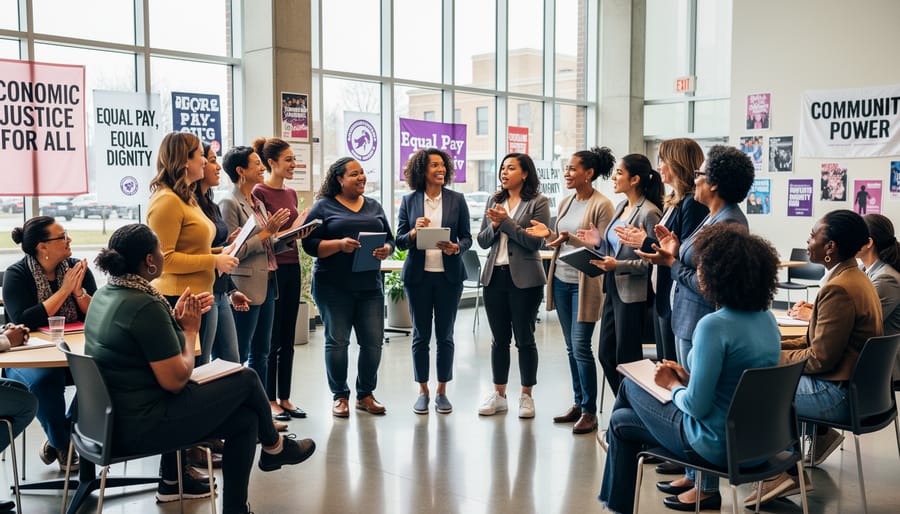
Economic justice isn’t an abstract economic theory or a distant policy goal. It’s about whether you can pay rent, afford groceries, save for emergencies, and build a stable future without working two jobs or sacrificing time with your family. At its core, economic justice means everyone has fair access to the resources, opportunities, and compensation they need to live with dignity and autonomy.
For Canadian women, this translates into concrete, daily realities: earning the same pay as male colleagues for the same work, having affordable childcare so you can stay employed, accessing credit to start a business without facing gender-based discrimination, and retiring with enough savings to live independently. It means your economic security doesn’t depend on a partner, and your caregiving responsibilities don’t derail your career or leave you financially vulnerable.
- Economic Justice
- Fair distribution of economic resources and opportunities so everyone can meet basic needs, participate fully in society, and build financial security regardless of gender, race, or background.
- Distributive Justice
- The principle that society’s economic benefits and burdens should be allocated equitably, ensuring no group bears disproportionate costs or is systematically excluded from prosperity.
- Pay Equity
- Equal compensation for work of equal value, addressing wage gaps that undervalue jobs traditionally held by women and ensuring transparent, non-discriminatory pay practices.
- Economic Security
- Having stable income, access to essential services, and sufficient savings to weather unexpected crises without falling into poverty or dependence.
Economic justice recognizes that these aren’t individual failures when women struggle financially. They’re systemic barriers built into how our economy functions. When single mothers can’t afford rent despite working full-time, when immigrant women with credentials can’t access jobs matching their skills, or when Indigenous women face hiring discrimination that limits their earnings, that’s economic injustice at work. Addressing it requires changing the structures that create and maintain inequality, not just helping individuals navigate broken systems.
How Economic Injustice Shapes Women’s Lives in Canada
The Wage Gap and Pay Transparency
Canadian women still earn less than men for comparable work, and the gap widens significantly for racialized and Indigenous women. In 2026, women earn approximately 89 cents for every dollar men earn, but this figure masks deeper disparities. Indigenous women earn roughly 65 cents on the dollar, and racialized women face similar penalties depending on their background. These gender wage gap facts reveal how economic injustice impacts women differently based on race and geography.
Provincial differences matter too. Women in Alberta and Ontario face larger gaps than those in Quebec or Prince Edward Island, often tied to industry concentration and weaker pay equity enforcement. The gap also grows with age as career interruptions for caregiving compound over time, shrinking retirement savings and pension contributions.
Pay secrecy makes these disparities worse. When employers discourage or prohibit salary discussions, women can’t identify when they’re underpaid or negotiate effectively. Without transparency, the same job can pay vastly different amounts to people sitting side by side, and those gaps follow patterns of gender and race. Pay transparency laws, now adopted in some provinces, help expose these inequities, but enforcement remains inconsistent and many workplaces still operate in silence.
Unpaid Care Work and the ‘Second Shift’

Canadian women spend an average of 3.9 hours per day on unpaid household work, nearly double the 2.4 hours men contribute. This unpaid work burden doesn’t just mean extra housework. It’s childcare during work calls, eldercare that forces reduced hours, and the mental load of managing a household while holding down a job. This “second shift” directly limits women’s earning potential and career advancement.
When women shoulder the majority of caregiving, they’re more likely to work part-time, turn down promotions, or leave the workforce entirely during critical earning years. That means smaller paycheques now and significantly reduced pensions later. A woman who takes five years out of the workforce to care for young children or aging parents can see her lifetime earnings drop by hundreds of thousands of dollars.
The economic penalty hits harder for single mothers and women caring for elderly relatives without support. They’re juggling impossible schedules with no backup, and workplaces often penalize flexibility with lower pay or stalled advancement.
Canada’s policy gaps make this worse. Affordable childcare remains out of reach in many provinces despite federal commitments. Parental leave doesn’t cover the full caregiving years, and elder care supports are patchwork at best. Until unpaid care work is recognized as an economic contribution, and supported with real infrastructure, women will continue paying the price for keeping families and communities running.
Access Barriers to Credit, Housing, and Entrepreneurship

Women seeking to build wealth through homeownership or entrepreneurship hit systemic walls that men rarely encounter. Banks and lenders still evaluate creditworthiness using models that penalize career gaps and part-time work, patterns disproportionately tied to caregiving responsibilities. A woman returning to the workforce after maternity leave may find her mortgage application denied despite stable income, simply because her employment history shows interruption.
For entrepreneurs, the barriers multiply. Women-owned businesses receive only four percent of venture capital funding in Canada, and women applying for small business loans face higher rejection rates and stricter collateral requirements than male counterparts with identical financial profiles. Indigenous women and racialized women report even steeper hurdles, often denied without clear justification.
Without access to capital, women cannot purchase homes that build generational wealth or launch businesses that offer financial independence. These gatekeeping practices keep economic power concentrated and make it nearly impossible for women to escape precarious financial situations. The result is widening wealth inequality that compounds across a lifetime and passes to the next generation.
Intersecting Identities and Compounded Disadvantage
Economic injustice doesn’t affect all Canadian women equally. Racialized women earn 67 cents for every dollar earned by white men, while Indigenous women earn just 65 cents. Immigrant women with credentials often find their qualifications unrecognized, pushing them into precarious work regardless of their education. Women with disabilities face both discrimination in hiring and workplace accommodations that rarely materialize, their unemployment rate sits nearly double that of non-disabled women.
These aren’t separate issues but overlapping systems that compound disadvantage. An Indigenous single mother faces barriers in housing, employment, and accessing credit that a white woman might never encounter. A Black woman entrepreneur confronts both gender and racial bias when seeking business loans, with approval rates significantly lower than her white counterparts. Understanding these layered realities is essential to building economic justice that actually works for all women.
Why Economic Justice Is a Women’s Rights Issue
Economic power isn’t just about buying groceries or paying rent, it’s about control over your own life. When women lack financial independence, every other right becomes harder to exercise. You can’t leave an abusive relationship if you have nowhere to go. You can’t make decisions about your body if someone else controls the bank account. You can’t run for office, start a business, or speak up at work when your survival depends on staying quiet.
This is why deconstructing patriarchy requires addressing economic barriers head-on. Financial dependence creates vulnerability. Canadian data shows that women facing intimate partner violence cite lack of money as the single biggest obstacle to leaving. Without income, savings, or access to credit, the choice to stay safe becomes a choice between danger and homelessness.
Economic inequality also restricts reproductive autonomy. Contraception costs money. Childcare costs even more. When women earn less and hold fewer assets, decisions about whether and when to have children aren’t truly free. A career setback from pregnancy can mean years of lost earnings, reinforcing the cycle.
Public participation suffers too. Women working multiple jobs to make ends meet don’t have time to attend city council meetings or organize community campaigns. Running for elected office requires financial stability most women don’t have. Leadership roles remain out of reach when you’re juggling unpaid caregiving with precarious employment.
The connection runs both ways. Achieving gender equality in any area, ending violence, securing reproductive rights, gaining political representation, requires economic justice as the foundation. You can’t build lasting change on financial instability. Economic power gives women the leverage to claim every other right, to leave situations that diminish them, and to shape the systems that govern their lives. That’s why this fight matters.
Policies and Frameworks That Advance Economic Justice for Women
Canada has a patchwork of policies aimed at advancing economic justice for women, but their effectiveness depends on implementation, enforcement, and political will. At the federal level, the Pay Equity Act came into force in 2021, requiring federally regulated employers to ensure equal pay for work of equal value. It’s a step forward, yet it covers only about 10 percent of Canadian workers, leaving the majority under provincial jurisdiction where protections vary widely.
The Canada-wide Early Learning and Child Care agreements, negotiated between 2021 and 2022, promised $10-a-day childcare across the country. By 2026, most provinces have made progress reducing fees, though waitlists remain long and rural communities still lack adequate access. For many women, affordable childcare is the difference between staying in the workforce and being forced out, so while the framework exists, the infrastructure hasn’t caught up.
| Policy | Jurisdiction | What It Covers | Gaps Remaining |
|---|---|---|---|
| Pay Equity Act | Federal | Equal pay for equal value in federally regulated workplaces | Excludes 90% of workers; weak enforcement mechanisms |
| Canada-Wide Child Care Agreements | Federal-Provincial | Subsidized childcare fees, aiming for $10/day | Long waitlists; rural gaps; inconsistent quality standards |
| Employment Equity Act | Federal | Requires equitable hiring for women, racialized groups, persons with disabilities | Limited to federal sector and contractors; lack of proactive enforcement |
| Ontario Pay Transparency Act | Provincial (ON) | Salary ranges in job postings; bans pay history questions | No penalties for non-compliance; other provinces lag behind |
Parental leave has expanded modestly, with the federal government allowing parents to extend leave up to 18 months at a lower benefit rate. But the challenge remains that benefits are tied to employment insurance eligibility, excluding gig workers, self-employed women without opted-in coverage, and those in precarious jobs.
Anti-discrimination protections exist under the Canadian Human Rights Act and provincial human rights codes, but enforcement is complaint-driven and slow. Women facing intersecting discrimination, racialized women, Indigenous women, newcomers, women with disabilities, often find the process inaccessible and the remedies inadequate.
In 2026, advocacy is focused on closing these gaps: expanding pay equity to all workers, enforcing pay transparency nationally, funding childcare infrastructure to meet demand, and reforming parental benefits to include contract and gig workers. The policies are a foundation, but without consistent funding, rigorous enforcement, and inclusive design, they fall short of delivering real economic justice.
What You Can Do to Support Economic Justice for Women
You don’t need to wait for sweeping policy changes to make a difference. Start by championing pay transparency in your workplace, ask your employer to conduct a pay equity audit, share salary information with colleagues when comfortable, and back legislation that requires transparent compensation ranges in job postings. When you normalize these conversations, you help dismantle the secrecy that lets wage gaps persist.
Advocate for affordable, accessible childcare by contacting your provincial and federal representatives. Tell them how childcare costs affect your community, and support women’s rights organizations pushing for expanded national programs. Attend town halls, sign petitions, and amplify the voices of parents struggling with impossible choices between work and care.
Make intentional choices with your wallet. Seek out women-owned businesses, especially those run by racialized, Indigenous, and immigrant women, and recommend them in your networks. Write reviews, share their work on social media, and mentor women entrepreneurs in your field.
Join local advocacy groups working on economic justice issues. Whether it’s a labour coalition, a women’s shelter fundraising campaign, or a community initiative for affordable housing, your time and presence matter. Collective action builds momentum that individual efforts can’t match alone. Show up, listen to those most affected, and use your privilege to open doors for others.
Common Questions About Economic Justice and Women’s Rights
Is the gender wage gap real, or is it explained by women’s career choices?
The gap is real and persistent even when controlling for education, experience, and occupation. Women earn less than men in nearly every field, and the penalty for motherhood alone accounts for a significant portion of lifetime earnings loss, choices don’t happen in a vacuum when caregiving falls disproportionately on women.
What can I do if I suspect I’m being paid less than male colleagues?
Document your work, research comparable salaries using resources like Glassdoor or industry surveys, and request a meeting with your manager to discuss compensation. If your employer has pay equity legislation obligations, you can file a complaint with the Canadian Human Rights Commission or your provincial labour board.
Where can women facing economic barriers find immediate support?
Start with local women’s centres, which often provide financial literacy workshops, employment counselling, and emergency funds. Provincial social services, community legal clinics, and organizations like the YWCA offer housing assistance, childcare subsidies, and entrepreneurship programs tailored to women’s needs.
How can men be effective allies in advancing economic justice for women?
Support pay transparency at your workplace, share caregiving responsibilities equitably at home, mentor and sponsor women colleagues for promotions, and use your voice in meetings and policy discussions to advocate for structural change. Allyship means leveraging your position to dismantle barriers, not just acknowledging they exist.
These questions come up repeatedly because economic injustice feels overwhelming and personal at the same time. You’re not alone in wondering whether the system can change or what your next step should be. The answers aren’t always simple, but clarity helps, and so does knowing that thousands of Canadian women are asking the same questions and organizing together for solutions. Whether you’re navigating your own pay gap, supporting a friend through a financial crisis, or trying to figure out how to make a difference from where you stand, your engagement matters. Economic justice isn’t built by experts alone; it’s built by communities demanding better and holding institutions accountable.
Moving Forward Together
Economic justice for women in Canada isn’t a distant dream, it’s a goal we’re actively building toward, one policy change, one workplace conversation, one community initiative at a time. We’ve seen real progress: national childcare agreements are expanding, pay transparency laws are gaining ground in several provinces, and more women are speaking openly about the wage gap and caregiving penalties that have long been brushed aside. These victories didn’t happen by accident. They came from women and allies who refused to accept the status quo, who organized, advocated, and demanded better.
Yet significant work remains. The wage gap persists, unpaid care work continues to limit women’s advancement, and marginalized women still face compounded barriers to housing, credit, and economic security. Progress isn’t linear, and setbacks are part of the journey. What sustains the movement is people like you recognizing why it matters and choosing to stay engaged, whether that’s advocating for stronger legislation, supporting women-owned businesses, or simply having honest conversations about fairness in your workplace.
Women Rights Canada exists to connect you with these efforts and to amplify the voices pushing for change. Economic justice isn’t something we wait for; it’s something we create together, through sustained commitment and shared action. Join us.