
 adrienne
Economic inequality refers to the unequal distribution of wealth, income, and economic resources across a population. In Canada and around the world, women experience this inequality differently and more acutely than men, earning less for comparable work, holding fewer leadership positions, and facing systemic barriers that compound over a lifetime.
When a woman earns 89 cents for every dollar a man makes, or when a single mother struggles to afford childcare that costs more than her rent, or when an Indigenous woman in a rural community lacks access to the same economic opportunities as her urban counterparts, that’s economic inequality at work. These aren’t abstract statistics. They represent real gaps in financial security, retirement savings, home ownership, and the ability to build generational wealth.
Understanding economic inequality matters because you can’t fight what you don’t fully see. The mechanisms that create and maintain these gaps operate quietly, from hiring biases to unpaid care work expectations to tax policies that favor wealth accumulation. For women in Canada, these forces intersect with gender, race, disability, immigration status, and geography, creating vastly different economic realities even within the same city.
This article breaks down what economic inequality actually means, how it functions in practice, the different forms it takes in women’s lives, and why recognizing these patterns is the first step toward meaningful change. You’ll walk away with a clear framework for understanding how inequality shapes opportunity and what levers exist to address it within your own community.
What Economic Inequality Means
Economic inequality refers to the uneven distribution of financial resources, opportunities, and economic power among individuals and groups in society. At its core, it’s about who has access to money, assets, and the ability to build financial security, and who doesn’t.
When we talk about economic inequality, we’re looking at differences that go beyond what someone earns at their job. It encompasses everything from hourly wages to accumulated wealth, from who owns property to who has savings for emergencies. These disparities shape people’s ability to afford housing, access education, retire comfortably, and weather financial setbacks.
To understand economic inequality fully, it helps to know a few key terms:
- Wealth gap
- The difference in total assets (property, savings, investments) between individuals or groups, measuring overall financial security rather than just income.
- Income disparity
- The unequal distribution of earnings from employment, investments, and other sources across a population.
- Wage gap
- The difference in pay between groups doing similar work, most commonly measured between men and women or across racial groups.
- Economic mobility
- The ability to improve one’s financial position over time, moving between income levels or building wealth across generations.
- Pay equity
- The principle that people should receive equal compensation for work of equal value, regardless of gender, race, or other characteristics.
These concepts overlap but measure different aspects of inequality. Someone might earn a decent income yet struggle to build wealth. Another person could have significant assets but limited economic mobility to increase their earnings. For women in Canada, these various forms of inequality often intersect, creating compounding disadvantages that affect financial wellbeing throughout their lives.
How Economic Inequality Works

Structural Factors That Create Inequality
Economic inequality doesn’t emerge from thin air. It builds from entrenched systems that channel women into lower-paid sectors and roles. In Canada, occupational segregation funnels women toward caregiving, education, and service industries while men dominate higher-paying fields like technology, trades, and finance. Even when women enter male-dominated sectors, they often hit barriers to advancement that keep them in junior positions with smaller paycheques.
Unpaid care work forms another structural pillar of inequality. Canadian women perform roughly two-thirds of all unpaid domestic labour and caregiving, from raising children to supporting aging parents. This invisible work forces many women into part-time employment or career interruptions, fracturing their earnings trajectory and retirement savings. Employers rarely account for these contributions when setting wages or evaluating promotions.
Discrimination operates through both overt bias and subtle systemic barriers that undervalue women’s labour. Hiring managers may unconsciously favour male candidates for leadership roles. Performance reviews penalize women for behaviours rewarded in men. Pregnancy and motherhood trigger wage penalties that persist for years. These patterns don’t require individual malice to function, they’re woven into workplace cultures and policies. Addressing economic inequality means deconstructing patriarchy at the institutional level, not just individual attitudes.
How Inequality Compounds Over Time
Small economic disadvantages early in a woman’s career don’t stay small. They multiply across decades, turning modest pay gaps into vast wealth chasms by retirement.
Consider a young woman entering the workforce. If she earns even five percent less than a male colleague doing identical work, that gap affects more than her immediate paycheck. She contributes less to her pension, accumulates smaller savings, and has fewer resources to invest. Meanwhile, her male counterpart builds wealth faster through higher base earnings, larger employer pension matches, and greater capacity to invest in property or markets.
Time becomes the enemy. A woman who takes maternity leave at thirty might miss promotions, salary increases, and years of pension contributions. She returns to work at the same or lower pay level while colleagues who remained continuously employed have advanced. That single career interruption reverberates for thirty-five years until retirement.
Compound interest, which builds wealth for those with capital to invest, works in reverse for women starting with less. Smaller initial investments grow more slowly. Lower lifetime earnings mean reduced Canada Pension Plan benefits. The retirement income gap between men and women in Canada exceeds forty percent, a chasm that began with seemingly minor disparities decades earlier.
Forms of Economic Inequality Affecting Women
Income and Wage Disparities
Canada’s gender pay gap sits at roughly 13 cents on the dollar, meaning women earn 87 cents for every dollar men make. That figure masks deeper divides. Women cluster in lower-paying sectors, healthcare support, retail, education, while men dominate higher-wage fields like finance and tech. Part-time work, where women make up 70% of workers, typically pays less per hour and rarely includes benefits or pension contributions.
The motherhood penalty hits particularly hard. Mothers earn about 12% less than women without children for the same work, while fathers often see wage bumps. Career interruptions for maternity leave, reduced hours to manage childcare, and workplace bias against mothers all compound the gap. A woman who takes time off or shifts to part-time work after having children may never catch up financially, even if she returns full-time later.
Racialized women and newcomers face steeper wage gaps still, with immigrant women earning significantly less than Canadian-born peers for years after arrival. These overlapping disparities don’t just shrink paycheques, they limit mortgage approvals, retirement savings, and financial independence at every stage.
Wealth and Asset Gaps
Women accumulate significantly less wealth than men throughout their lives, a gap that extends far beyond annual income. In Canada, single women own about half the net worth of single men by retirement age, a disparity rooted in decades of smaller paycheques, career interruptions, and limited access to wealth-building opportunities.
Property ownership represents one of the starkest divides. Women are less likely to own homes, and when they do, their properties typically hold lower values. Mortgage approval rates favour men, and women more often enter homeownership later or not at all, missing years of equity growth that forms the foundation of most Canadian families’ wealth.
The investment gap compounds these challenges. Women hold smaller retirement savings accounts and invest more conservatively, often due to lower disposable income rather than choice. When every dollar counts for immediate needs like childcare or groceries, long-term investing becomes a luxury many cannot afford.
These asset gaps mean women have less financial cushion during emergencies, fewer resources to leave their children, and reduced economic power to shape their futures. Wealth isn’t just about comfort, it’s about security, opportunity, and independence.
The Invisible Economy: Unpaid Care Work

Unpaid care work, cooking, cleaning, childcare, elder care, forms the backbone of every household and society, yet it carries no paycheque and builds no pension. In Canada, women perform roughly two-thirds of all unpaid domestic labour, dedicating an average of 3.9 hours daily compared to men’s 2.4 hours. This invisible workload doesn’t just vanish from economic statistics; it actively drains women’s earning potential.
Every hour spent caring for aging parents or preparing family meals is an hour unavailable for paid employment, career advancement, or professional development. Women who reduce work hours or leave jobs entirely to manage care responsibilities see immediate income drops and long-term consequences: smaller CPP contributions, reduced retirement savings, gaps in employment history that limit future opportunities.
The pandemic laid bare this imbalance. When schools and daycares closed, mothers disproportionately shouldered the additional caregiving burden, with nearly 250,000 Canadian women leaving the workforce in 2020. This unpaid labour subsidizes the economy, without it, paid care services would cost billions, yet the women performing it pay the price through diminished economic security and widening wealth gaps that persist across their lifetimes.
Where Economic Inequality Shows Up in Women’s Lives
In the Workplace
Economic inequality reveals itself from the moment women enter the workforce. Canadian women continue to face hiring bias in male-dominated fields, despite possessing equivalent qualifications. Studies show resumes with female names receive fewer callbacks for positions in technology, finance, and trades.
Promotional pathways prove even more uneven. Women occupy only 29% of senior management roles in Canadian companies, despite making up nearly half the workforce. The climb to leadership slows at every rung, particularly for mothers and women of colour.
Access to workplace flexibility creates another divide. While remote work and flexible hours can help women balance caregiving responsibilities, these arrangements often come with unspoken penalties. Workers requesting flexibility may be perceived as less committed, passed over for high-visibility projects, or excluded from informal networking that drives advancement. Men who request flexibility face similar stigma, yet women remain far more likely to need and request such accommodations, making this a gendered barrier to equal economic opportunity.
In Family and Caregiving Roles
The “motherhood penalty” shows up in reduced earnings, fewer promotions, and interruptions to pension contributions that women rarely fully recover from. Canadian mothers earn approximately 12% less per child than women without children, while fathers often see an earnings bump. This gap widens when women reduce hours or step away from work to care for young children, losing years of raises and advancement opportunities.
Elder care responsibilities fall disproportionately on women, with many leaving the workforce or cutting back hours in their peak earning years to support aging parents or spouses. These caregiving years strip away income and retirement savings exactly when women should be building financial security.
Relationship breakdowns frequently expose women’s economic vulnerability. After divorce or separation, women’s household income typically drops by 20% to 30%, while men’s often increases. Those who took career breaks for caregiving find themselves with employment gaps, outdated skills, and fractured pension entitlements that leave them economically disadvantaged for decades.
In Retirement and Later Life
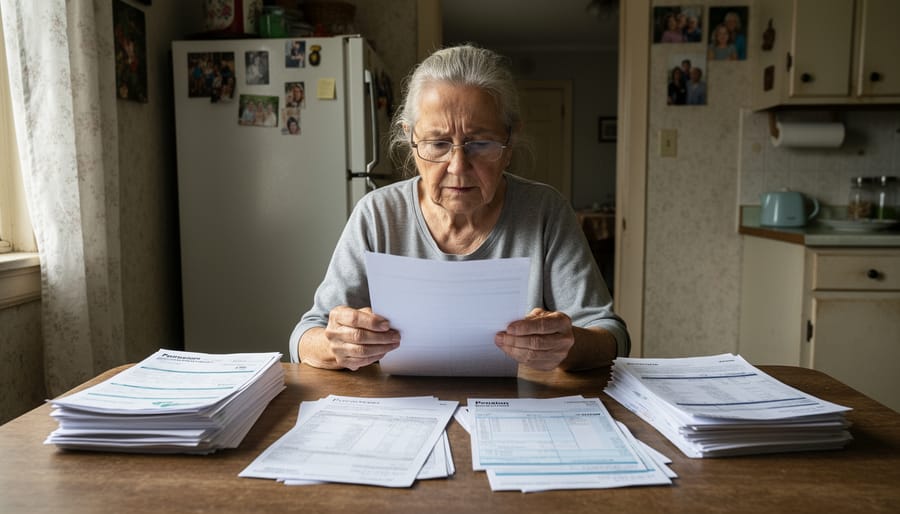
Women reach retirement carrying the accumulated weight of a lifetime’s economic disadvantages. The pay gaps, career interruptions, and reduced working hours from earlier decades translate directly into smaller pension contributions and government benefit calculations based on lifetime earnings.
Canadian women over 65 face poverty rates significantly higher than men in the same age group. Many spent years in part-time or precarious work that didn’t include pension benefits, or took time away from paid employment for caregiving without building retirement savings. Divorced and widowed women are particularly vulnerable, often having lower personal pensions due to interrupted careers while married.
The result is stark: older women are more likely to struggle with housing costs, healthcare expenses, and basic necessities. Economic inequality doesn’t end at retirement, it intensifies, leaving many women financially insecure precisely when they’re least able to change their circumstances.
Who Is Most Affected by Economic Inequality
Economic inequality doesn’t affect all women the same way. While gender creates barriers across the board, women with multiple marginalized identities face compounding disadvantages that deepen their economic exclusion.
Indigenous women in Canada experience some of the starkest inequalities. They earn roughly 35% less than non-Indigenous women and face significantly higher rates of poverty. Historical policies like residential schools disrupted intergenerational wealth transfer, while ongoing systemic barriers limit access to education, employment, and safe housing. Women living on reserves often lack the property rights that enable wealth building elsewhere.
Racialized women encounter persistent wage penalties even after accounting for education and experience. Black and Filipina women are overrepresented in precarious, low-wage care work. South Asian and Chinese women frequently work in family businesses without formal employment protections or pension contributions. Recent immigrants face credential recognition barriers that push highly educated women into survival jobs far below their qualifications.
Women with disabilities earn approximately 20% less than non-disabled women and face double the unemployment rate. Workplace accommodations remain inadequate, part-time work is often their only option, and expensive medical costs drain already limited incomes. Many depend on inadequate disability benefits that keep them below the poverty line.
Single mothers, particularly those who are racialized or recent immigrants, struggle with childcare costs that consume half their income or more. Without family support networks or flexible employers, they cycle between precarious jobs and social assistance.
These intersecting inequalities aren’t accidental. They reflect deliberate policy choices and institutional practices that concentrate resources among those already privileged. Advancing economic justice means recognizing these layered barriers and designing solutions that address the specific challenges faced by Canada’s most marginalized women.
Common Questions About Economic Inequality
Is the gender wage gap really real, or is it just a myth?
Yes, the gender wage gap is real and well-documented across Canada. While some argue it’s solely due to career choices, research consistently shows that women earn less than men even when controlling for education, experience, and occupation, discrimination and systemic barriers contribute significantly to this disparity.
Why do women earn less over a lifetime, not just annually?
Women face compounding disadvantages throughout their careers: they often start at lower salaries, experience slower wage growth during caregiving years, and accumulate less in pensions and retirement savings. These gaps multiply over decades, resulting in substantially less lifetime earnings and wealth compared to men.
Does higher education eliminate the economic gap for women?
Education helps but doesn’t eliminate inequality. University-educated women still earn less than their male counterparts in the same fields, and they’re underrepresented in high-paying leadership roles. The “motherhood penalty” affects professional women across all education levels.
What can individuals actually do about economic inequality?
Advocate for pay transparency at your workplace, support policies like affordable childcare and paid parental leave, negotiate your salary confidently, and get involved with organizations advancing women’s rights. Individual actions combined with collective advocacy create meaningful change.
These questions reflect what many Canadian women wonder when confronting economic inequality in their own lives. Understanding that the wage gap persists despite qualifications helps frame it as a systemic issue rather than a personal failing.
The career choice argument deserves particular scrutiny. While women do concentrate in certain sectors, those fields often pay less precisely because they’re female-dominated, a phenomenon called occupational devaluation. Even within the same profession, women face promotion barriers and negotiation disadvantages that men don’t encounter.
Single mothers experience economic inequality most acutely. They shoulder caregiving responsibilities alone while facing workplace discrimination, limited access to flexible jobs that pay living wages, and inadequate social supports. The intersection of gender and family structure creates particularly steep financial challenges.
Addressing these inequalities requires both individual empowerment and structural change. Women can strengthen their financial positions through salary negotiation, career planning that accounts for caregiving interruptions, and building supportive networks. But personal strategies only go so far when the rules themselves are tilted. That’s why policy advocacy, pushing for pay equity legislation, universal childcare, and fair tax treatment of caregivers, matters just as much as individual action.
Economic inequality isn’t just an abstract concept, it’s a tangible force shaping the lives of Canadian women every day. From the wage gaps that shrink paycheques to the wealth disparities that limit retirement security, these inequalities compound over time, affecting everything from career opportunities to caregiving responsibilities. The mechanisms that create these gaps are deeply rooted in systemic structures, from labour market segregation to the undervaluing of unpaid care work, and they intersect with race, disability, and immigration status to create profoundly different experiences for different women.
Understanding economic inequality is the first step toward dismantling it. When we recognize how structural factors create and perpetuate these gaps, we can push for policies that address the root causes, equal pay legislation, affordable childcare, pension reform, and support for caregivers. But knowledge alone isn’t enough. Real change requires collective action, community engagement, and sustained pressure on institutions to do better.
That’s where each of us comes in. Whether it’s supporting organizations working toward economic justice, advocating for policy changes in your community, or simply starting conversations about these issues, advocacy today creates the foundation for a more equitable tomorrow. Economic equality for women isn’t just a women’s issue, it strengthens families, communities, and the economy as a whole. Together, we can build a Canada where economic security is a reality for all women.